Stand Taller, Pull Harder: The Outdoor Bootcamp Workout Your Back Has Been Begging For
Take a second and notice how you’re sitting right now. Shoulders creeping toward your ears? Chin jutting forward? That’s not a personal failing — it’s the default setting for anyone who spends their day hunched over a screen, a steering wheel, or a phone. And the muscles paying the price are almost always the same ones: your back.
Here’s the thing most people don’t realize about posture — it isn’t really about “sitting up straight.” It’s about strength. Your spine doesn’t hold itself upright on its own; it relies on a sling of muscles running up your back — lats, rhomboids, traps, rear delts — to keep your torso stacked and your shoulders pulled into place. When those muscles are weak or under-trained, your body compensates by rounding forward, and that rounded position becomes the new “normal” the longer it goes unchallenged.
The fix isn’t a posture brace or a reminder app pinging you every hour. It’s pulling. Rows, pulls, hangs, and carries all force your back muscles to fire, contract, and get stronger at holding you upright — which is exactly what they’re designed to do all day, every day, not just during a workout.
Why Pull Exercises Deserve Equal Billing With Push Day
Most casual lifters gravitate toward “mirror muscles” — chest, shoulders, arms — and quietly neglect the muscles they can’t see. But pull-focused training earns its place in any well-rounded routine for a few concrete reasons:
- Heading 4- It builds the muscles that fight gravity for you. Your erector spinae, lats, and rhomboids work all day to keep you upright. Training them directly makes that job easier and less fatiguing.
- Heading 4-It balances out “push-dominant” lifestyles. Desk work, driving, and scrolling all pull your shoulders forward. Rows and pulls counteract that by strengthening the opposing muscle group.
- Heading 4-It protects your shoulders long-term. A strong back stabilizes the shoulder blades, which reduces impingement risk and makes pressing movements safer too.
- Heading 4-It builds serious grip and forearm strength. Farmer’s carries, dead hangs, and kettlebell swings all demand a crushing grip — which carries over to everything from opening jars to deadlifting more weight.
- Heading 4-It’s one of the most efficient ways to build a strong, capable-looking back — the kind that fills out a t-shirt without a single bicep curl.
The Workout: Outdoor Pull Workout
No gym required. Grab a set of dumbbells, a kettlebell, and find a patch of grass, a park bench, or a low branch — this circuit is built to move outside.
Warm-Up (5–8 minutes)
- Arm Circles + Band Pull-Aparts — 1 minute each direction (swap for arm swings if you don’t have a band)
- Bodyweight Good Mornings — 15 reps
- Scapular Pull-Ups or Scap Squeezes — 15 reps (use a bar or branch if you have one)
- Inchworms to Hamstring Stretch — 8 reps
Main Circuit — 4 Rounds
Rest 60–90 seconds between rounds.
- Dumbbell Bent-Over Rows — 12–15 reps Hinge at the hips, keep your back flat, and row the dumbbells to your ribs, squeezing your shoulder blades together at the top.
- Kettlebell Swings — 15–20 reps A hip-hinge power move that drives the posterior chain and doubles as a pulling and grip challenge on the backswing.
- Renegade Rows (Dumbbells) — 10 reps per side From a plank position, row one dumbbell up while stabilizing with the other arm — this hits your lats and core at the same time.
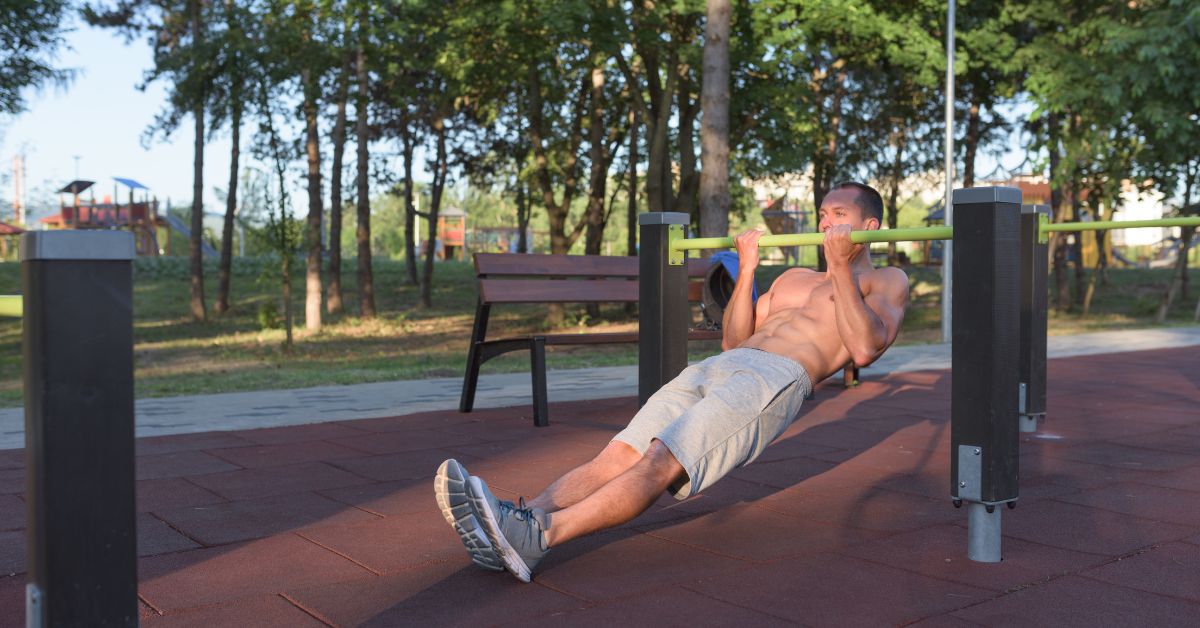
- Inverted Rows / Bodyweight Rows — 10–12 reps Use a low branch, playground bar, or picnic table edge. Walk your feet forward to make it harder.
- Kettlebell High Pulls — 12 reps An explosive pull from a swing into a high pull at chest height — great for traps and rear delts.
- Single-Arm Dumbbell Row — 10 reps per side Split stance or set up on a bench or step, driving your elbow back and up.
Grip & Finisher — 2 Rounds
- Farmer’s Carry (dumbbells or kettlebells) — 30–40 yards
- Dead Hang from a bar or branch — 20–30 seconds (or a towel pull-hold if no bar is around)
- Bear Crawl — 20 yards
Cool-Down (5 minutes)
- Standing Lat Stretch — 30 seconds per side
- Doorframe or Pole Chest Stretch — 30 seconds per side
- Child’s Pose or Seated Forward Fold — 1 minute
- Wrist and Forearm Stretches — 30 seconds each
Coaching Notes
- No pull-up bar or sturdy branch? Swap the inverted rows for an extra set of renegade rows or single-arm rows.
- No kettlebell? Hold a single dumbbell vertically and use it for the swings and high pulls.
- Running this for a group? Set it up as timed stations — 45 seconds of work, 15 seconds to transition — with a coach cueing the clock. Works well for groups of 6 to 15.
Your back is quite literally what’s holding you up.Train those muscles the way they desrve it, and the payoff isn’t just a stronger pull — it’s a body that stands taller without having to think about it.
This post was originally a 9 to 5 wellness podcast and was posted on aeshatahir.com.